
New State Artist Spotlight
By Haley Swenson, Interviewed on April 16, 2026
“You have a lot of nods to the Midwest woven throughout your work. Are you from the area?”
I was technically born in Chicago, but when I was 7, my family moved up to Milwaukee. I grew up in Milwaukee, truly, that’s home to me.
“Even more than just acknowledging the Midwest, it looks like you draw inspiration from different Midwest landscapes. What is it about this area that is inspiring to you?”
I’ve always been so freaked out and in love with Lake Michigan… I have equal parts fear and awe whenever I see it. The rivers and the watershed create such intense greenery in the summertime. And such, as I see it, mood swings for the lake. It expressed to me a lot about the external reflecting the internal. There were days I would walk down to the lake, and it would have the same mood as me. It made me feel seen as a teenager when I was feeling very moody. Or the opposite, I would go down on a gorgeous day and feel like the world contains so much more than what I could see from my limited perspective. The Great Lakes region holds a special place in my heart. We are living these classic, Midwest-nice little lives, working away at our day-to-day, but we have these huge bodies of water, these beings, almost, that are so intense and beautiful. It pairs nicely with the simple, Midwestern way of life.
“On Rokeby, your new album, you mention grief, love, and heartbreak, connecting those personal themes and experiences with themes of nature. What were those connections for you? Specifically, what called on you to create a project that honors those themes?”
All of these songs came from this 10-day dogsitting gig where I went back to upstate New York, where I used to go to school… It’s a beautiful, beautiful part of the world, and it’s also a part of the world where I have a lot of memories, a lot of grief, and a lot of love. I was there when the pandemic hit. I kind of became the person I am today, or at least I started on that path when I lived there. Returning there, and returning to that landscape– the river and the mountains– was also returning to this version of myself that I had, sort of, been running from—this grieving part.
That week-long trip was about being a part of that land. In the countryside, walking the dog every day, being in touch with the natural world, and feeling my feelings at the same time. It felt like a natural pairing… I would walk somewhere, a memory would emerge, and I would fall apart, and then build myself back up, and a song would just appear to me. That’s how the majority of the songs on the record happened: they appeared.
“Could you talk a little more about that 10-day experience? Specifically, the technical process? What was your day-to-day routine like creating this project?”
I’d wake up, feed the dog, go on a walk… I’d go down to the river, and I would see her, and she would see me right back. And all of the flood of memories and feelings would come. By the time I got back, the dog would take a nap, and I would sit out on the porch with my guitar, and I would just play until the music felt the way that I felt. Once I found a chord progression or tone that I liked, I’d start singing and see what words emerged. I’d write them down, go back over them a couple times, and leave [the song] to make lunch, walk the dog again… In the early evenings, I would come back to it and whittle away– What is it that the song is trying to say? Which part of the process, emotionally, is this geared into? What’s it asking for? So, I’d finish the songs off in the early evenings, writing-wise, and move on when the next day came. I let the songs be of that day, and didn’t get too attached by overworking them.
“Did each song come from each day that you were there?”
The first five songs did. I wrote a lot of other ones that were not as ready to be published while I was there. The last five songs were songs that I wrote after I got home. They were, sort of, ideas that I started while I was there.
While I was out there, I met someone and fell in love in a really powerful way, and spent the summer in a long-distance relationship. It all came to an end in a pretty sad and confusing way that left me with that same grief that I felt when I went to Rokeby, so it all just felt connected again. I started writing again, and those fragments became songs of present grief, where the other ones were memories of grief. I decided that instead of layering all of my production skills and instruments on top of them, I wanted it to be really raw in recording. I recorded those with my friend, Will Hansen, who’s in a band called “Old Pup” in Milwaukee. We set up a tape recorder in his apartment, and I just sat down and fell into the songs. That’s how the record rounded off, those very personal songs.
“You said 'rounded off,’ and it all does feel very full circle. You saying that they were raw and pared down is perfect because the story itself is so full.”
[Sighs] It needed to happen. I sometimes find that when playing the songs and listening to them, I feel that urge to want to go back and do them over, or change them. But, it really was a very clear period of my life that began and, in some ways, will end in that place, in Rokeby. I’m going back this summer to dogsit again in July, which will be when my touring is winding down for the year, at least in the Midwest. I like when art pieces are just about the place and the time that they were made. I’m a perfectionist, but there’s something beautiful about accepting a time and place and person that you are, and just expressing that. That’s how this feels to me. It’s a time capsule that I’ll be able to look back at if I get to be very old. I just saw my 94-year-old grandmother this morning, and I’m thinking about how I’m going to look back on my life. These first two records– they are who I was, who I am. I like that.
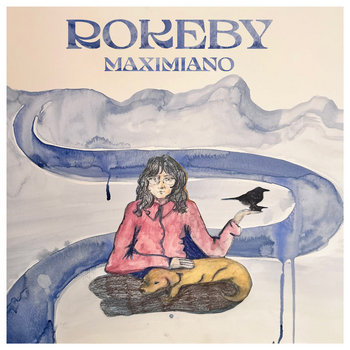
“I love your album cover. It’s a great icon for that 10-day experience, for what the album represents– there’s the dog, there’s the river, there’s you taking it in. I saw videos on your Instagram of you having what seems like genuine fun with non-instruments. You were tapping tables, creating rhythms, and you included birds chirping on the album. How did those elements become something that you wanted to include?”
Every day I’d walk the dog and find myself in some new corner in a field, or by the train tracks, or sitting on the porch, and a new sound would appear. I’d just put my phone down and start recording, and I treated it as a little meditation. I’d record for 2 minutes, and I’d sit there and listen. I knew, “I’m going to use these at some point, I don’t know what for, but I’m just going to collect these moments.” Those bird sounds, the sound of the wind, the sound of the door, the sound of the dog’s collar jingling as we’re walking– those were emblematic. What you said is true, the album cover is an icon, and the sounds are as well. They were important to put me back in that immediate place. I like creating environments. It’s easy, with the technology we have nowadays, to make things sound “perfect,” with no incidental sounds. So I like choosing what world the song is, what outside-of-the-instruments you’re hearing. It feels more human.
“I’m curious how Rokeby has expanded from your previous project.”
The previous project had that raw enthusiasm of “I’m just going to try absolutely anything.” The first record is an excited version of me that was moving with a lot of joy, but not a whole lot of discernment. I love that record, and I wouldn’t change a thing. This time around, I took a few classes on mixing, producing, and recording, and I used this record as a simplifying exercise. I wanted to find “What could I do if I put these constraints around myself to work closely with what I had?” …The first record had all sorts of friends on it; this record– there are a few friends that recorded on it, but for the most part, it was a solitary effort.
I know what I’m capable of on my own now. I have grown in my confidence and my skills. I do sense, though, that the next songs that I’ve been writing are going to include more “big band” energy with lots of instruments and friends. But I wouldn’t be able to feel confident with a more expansive space if I hadn’t settled back into what my core is– my folkier influence. Which, a lot of times, I want to abandon for something more experimental, but with this project, I leaned fully into my upbringing with folk music. Especially with that Bandit’s Song, “Puppers,” it sounds right out of the “O Brother, Where Art Thou” soundtrack. It’s so jingly jangly, and I would usually feel really self-conscious about playing that style of music. But because of the dog, and this record being about honesty, I was like, “Well, I grew up listening to that style, so I might as well honestly portray it, at least in one song.” So I got to experiment with that and go back to my roots. But I do feel a springboard to do something more experimental soon.
“What are you looking forward to in your own music, and in life?”
I look forward to my tours. The intention I put into touring is to find, in each new town, the people who are working to horizontally expand. There’s this fallacy around vertically expanding to find success, to climb ladders, and “get more.” But the truth is that there are communities of people, independent of institutions, that are making life livable for each other. So many of those communities are engaged with making art and building spaces where making music can be appreciated without centering profit. Ironically, it’s those places that I can sustain my living because those places are kind enough to host me– letting me stay in their guest rooms, buying my records to support… It’s more in line with the ethics I share… It’s those communities that don’t fail. They’re more prepared for the collapse of institutions because they’re based more on mutual aid…My excitement right now comes from being able to see how resistance movements in different towns are being sustained. And how they are making themselves more fortified as other things fall away. That gives me so much hope. Every town has this; every place has people working together to make life last.
“What else would you like people to know about your music and your art?”
My music is not on Spotify, which is a choice I made in solidarity with a lot of musicians in this industry right now. There are ways to engage with art outside of the systems of domination that are available to us. Going to house shows, directly buying people’s music, on Bandcamp, or physically. Or other streaming systems like Tidal or Qobuz that are not so exploitative and aren’t directly funding genocides. I would like people to know that my music is made with the intention of trying to live with integrity and beauty as the foundation, and seeing what we can do with that. I like that music is a medium that brings people together. I like that it’s a way to open us emotionally to ourselves and to our environment. It’s a great first step; it opens us to each other. I would like my music to help people feel what they need to and use that fortification to help one another. The time is now to put all of our work into one another. [Laughs] or something like that!
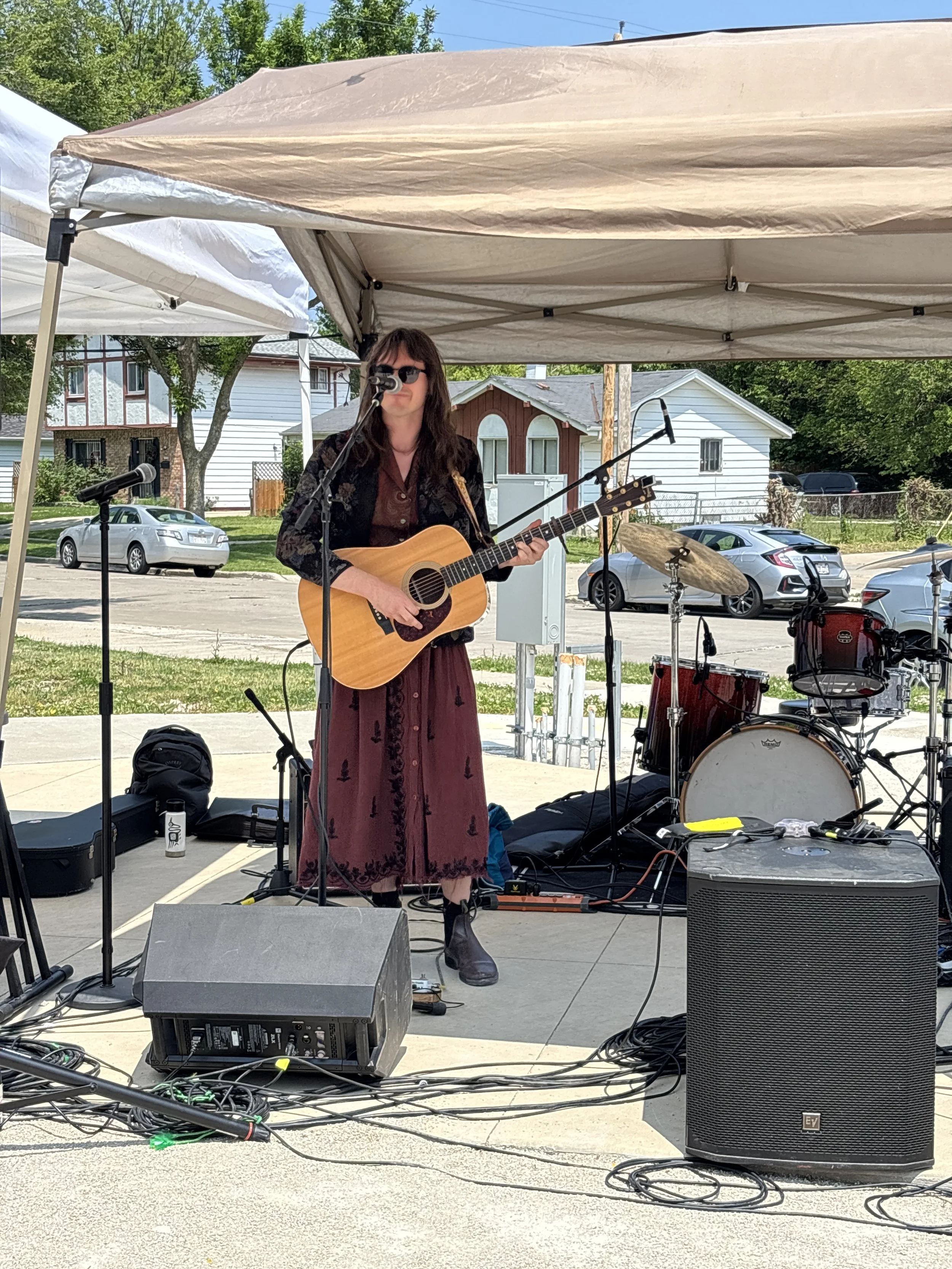
Maximiano performed at The New State Music Park in summer of 2025
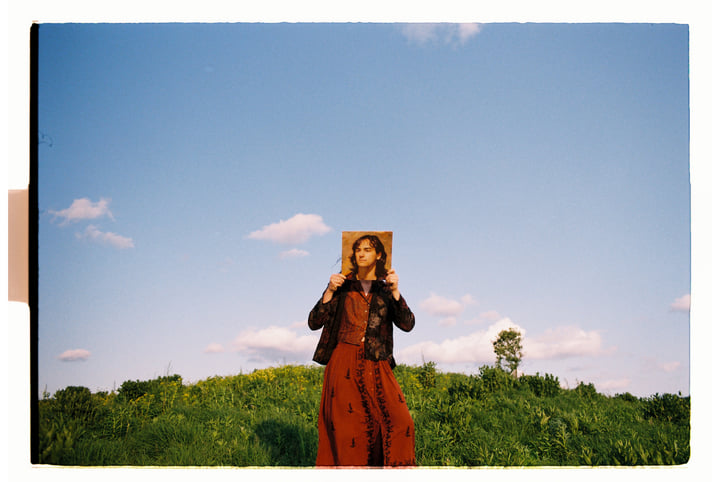
They will be performing at Washington Park Wednesdays on August 26th 2026